What the Zapier RSS trigger can't do with news feeds
On 2026-11-02, on a Zapier Professional (Pro) trial, RSS by Zapier polled our feeds every 104 to 133 seconds (the editor shows a "2 min" badge). Trigger polls cost 0 tasks, while a counted action step cost 1 task per run. The trigger has no header or Bearer field, only Feed URL, Username and Password. A Google News feed gave us a redirect link and an HTML snippet, with no article text.
If your end goal is an LLM step, the background is in feeding news to an LLM. For the build-or-rent choice, see RSS to webhook.
We built one Zap on a Zapier-hosted feed (RSS by Zapier's "Create Item in Feed" action, which assigns every item a new random guid) and one on a real Google News search feed that ran for 57 minutes. The polling numbers come from one trial account on one day. What we did not test lists the gaps.
What RSS by Zapier gives you
RSS by Zapier has two polling triggers: "New Item in Feed" and "New Items in Multiple Feeds".
Trigger inputs
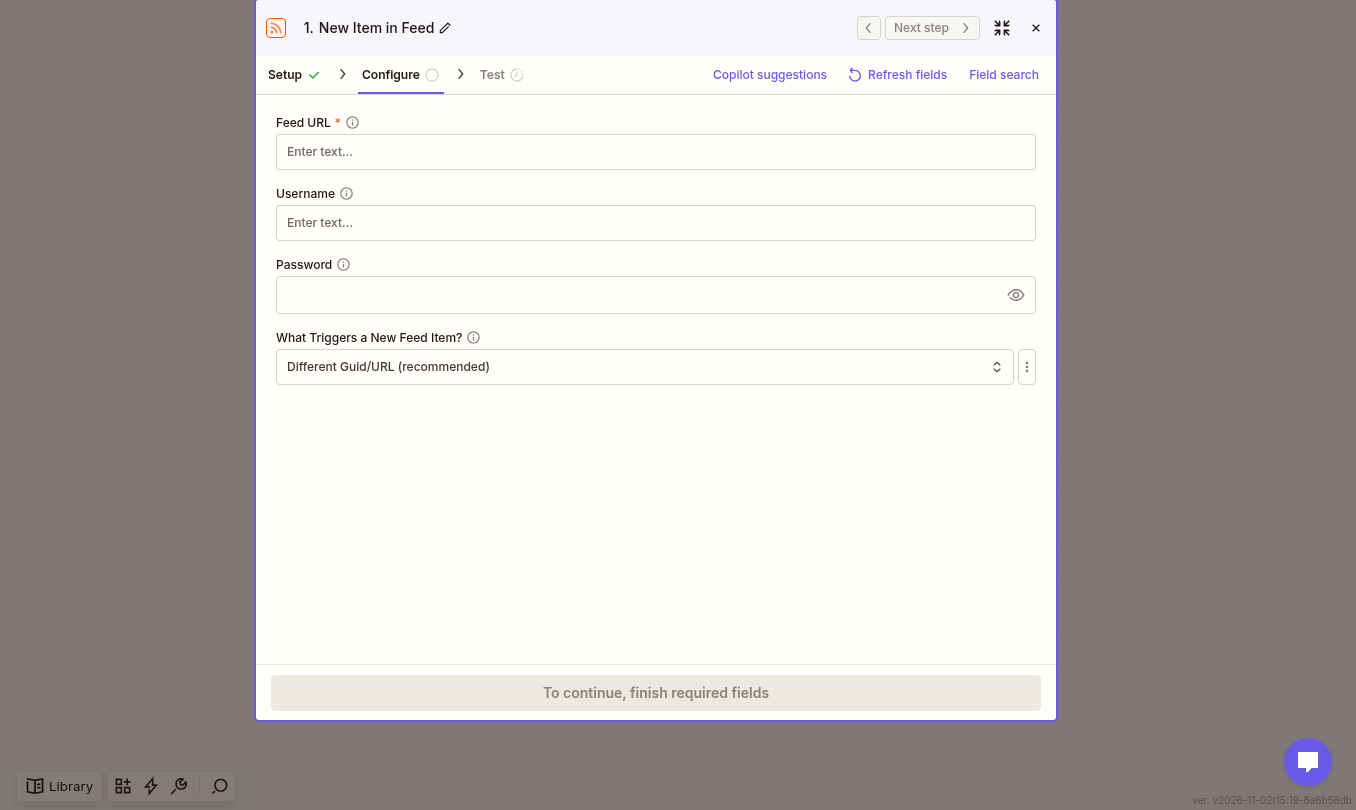
"New Item in Feed" has four inputs: Feed URL, Username, Password, and "What Triggers a New Feed Item?". That last one offers "Different Guid/URL (recommended)", "Different Content" and "Anything is Different". There is no header field and no token field.
Fields in the test step
The test step returns up to 3 sample items. A normal item gives you title, link, description, pub date, guid and an ID, plus a "raw" copy of the feed's own values. Content was empty on both feeds we tried.
How often a Zapier RSS feed trigger polls
The editor showed a "2 min" badge on the trigger card. We measured it. On the Professional trial, gaps between polls that found something were 104 to 133 seconds, so roughly every 2 minutes with jitter. A new item took 44 to 114 seconds to start a run in our single-item tests.
We could not find a current Zapier help page for update times: the article we tried returned an unrelated page on 2026-11-02. Treat our numbers as one plan on one day.
The first poll after turning a Zap on did not fire for items already in the feed. That held on both feeds, though the one item already in our controlled feed had also been pulled as a test sample. On Google News the first run came 8.5 minutes after turn-on.
Zapier RSS trigger task usage
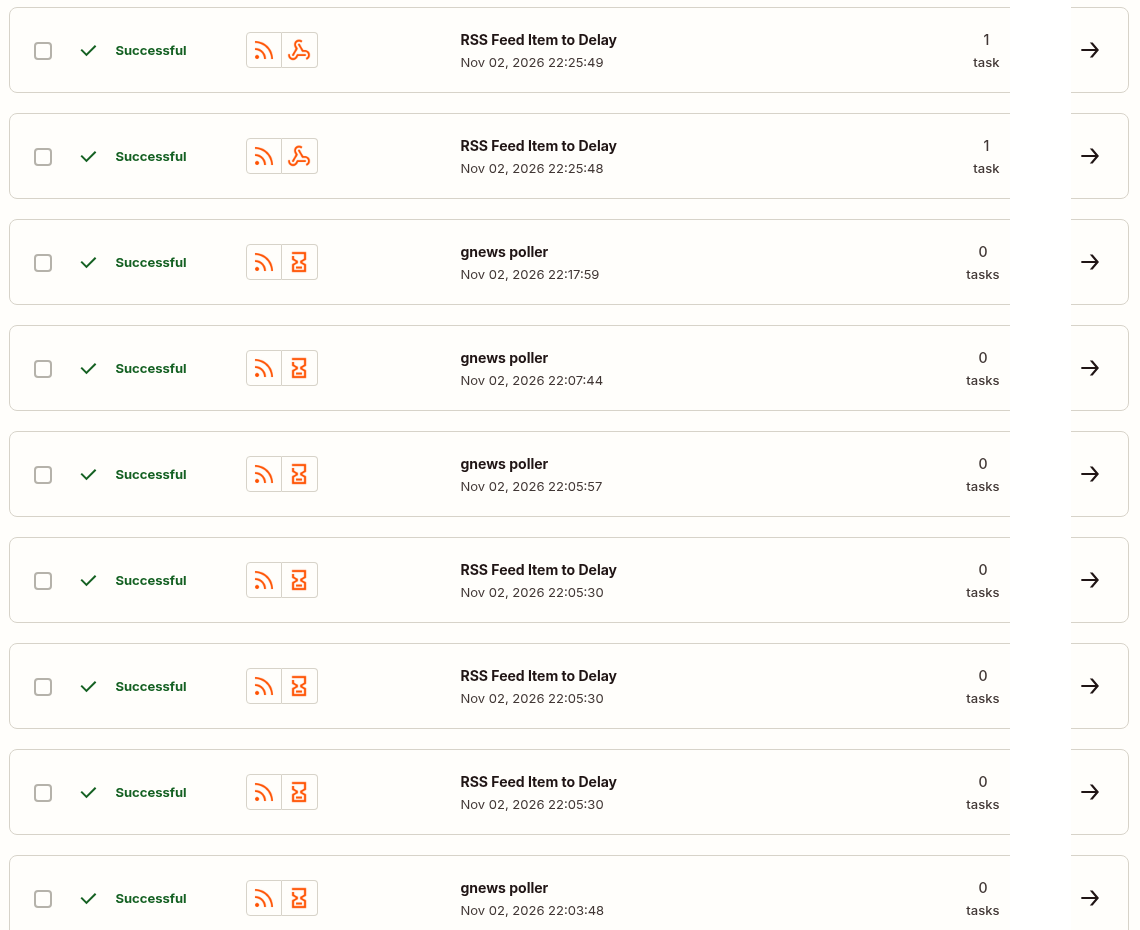
The trigger poll and a Delay by Zapier step both showed 0 tasks per run in Zap history. After 35 runs the billing page still read 0 / 1,000. A counted action step, a Webhooks by Zapier GET, showed 1 task per run. After two such runs the page read 2 / 1,000.
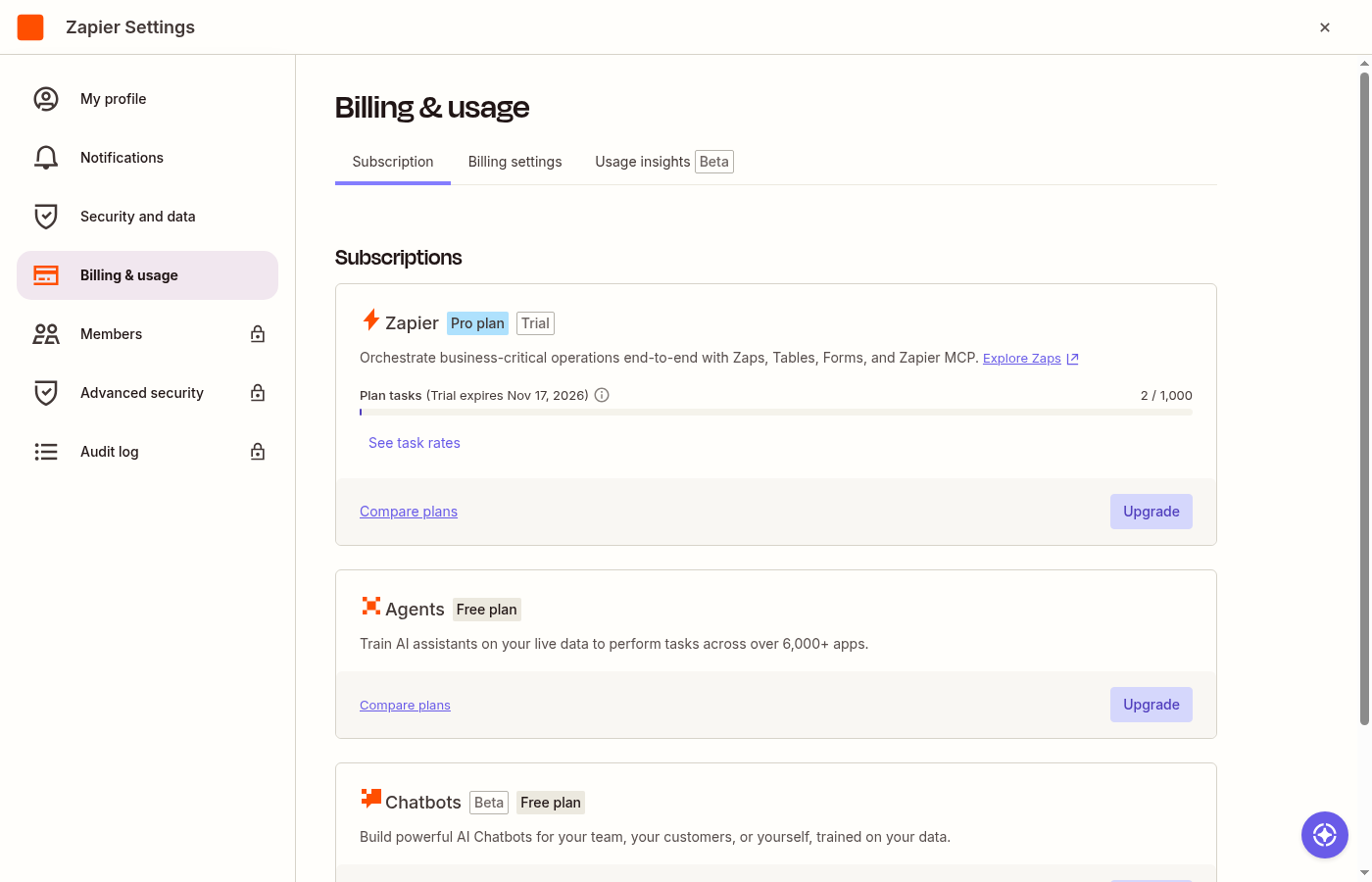
Polls that found nothing used no tasks. About 40 test-step clicks in the editor used none either. So the cost is the steps after the trigger, once per new item.
The Zap history shows it per run. Times here are UTC+1.
How the trigger handled new, repeated and old items
Our controlled feed was a Zapier-hosted one, made with RSS by Zapier's "Create Item in Feed" action. It gives every item a fresh random guid and offers no way to set one. That limits what we could test. Results:
| Case | Result |
|---|---|
| 1 new item | Triggered, 57 seconds later |
| Same title, link and body as an earlier item, new guid (default style) | Triggered, 44 seconds later |
Item with a pubDate of 2020-01-01 |
Triggered, 114 seconds later |
| 6 distinct items created about 22 seconds apart | 6 of 6 triggered, in two poll batches (3 each) |
| 6 identical items, new guid each, 3 to 4 seconds apart | 6 of 6 triggered |
| Style "Different Content", identical title, link and body, new guid | Did not trigger, over 4 polls |
| Style "Different Content", same title and link, changed body | Triggered |
Three things follow. A new guid is a new item, even if everything else matches. An old pubDate did not stop the one item we tried, so the trigger did not filter it by date. And "Different Content" does suppress an exact repeat, at the cost of missing a repeat you might want.
Saving a new version of the Zap with a different style did not re-fire the 16 items already in the feed.
Why the Zapier RSS trigger doesn't fire
These are the causes we saw:
- The item was already in the feed when you turned the Zap on. The first poll did not fire for existing items on either feed.
- You picked "Different Content" and the new item's content matched an earlier one.
- You changed the trigger style on a Zap that was already running. Saving a new version did not re-fire the items already in the feed.
We could not reproduce same-guid edits or feed caching (see below).
Google News links and duplicate stories
For the second Zapier RSS feed we used a real Google News search for offshore wind. The trigger's test step showed a news.google.com/rss/articles/...?oc=5 link. The guid is the same ID without the URL around it. Neither is the publisher's URL.
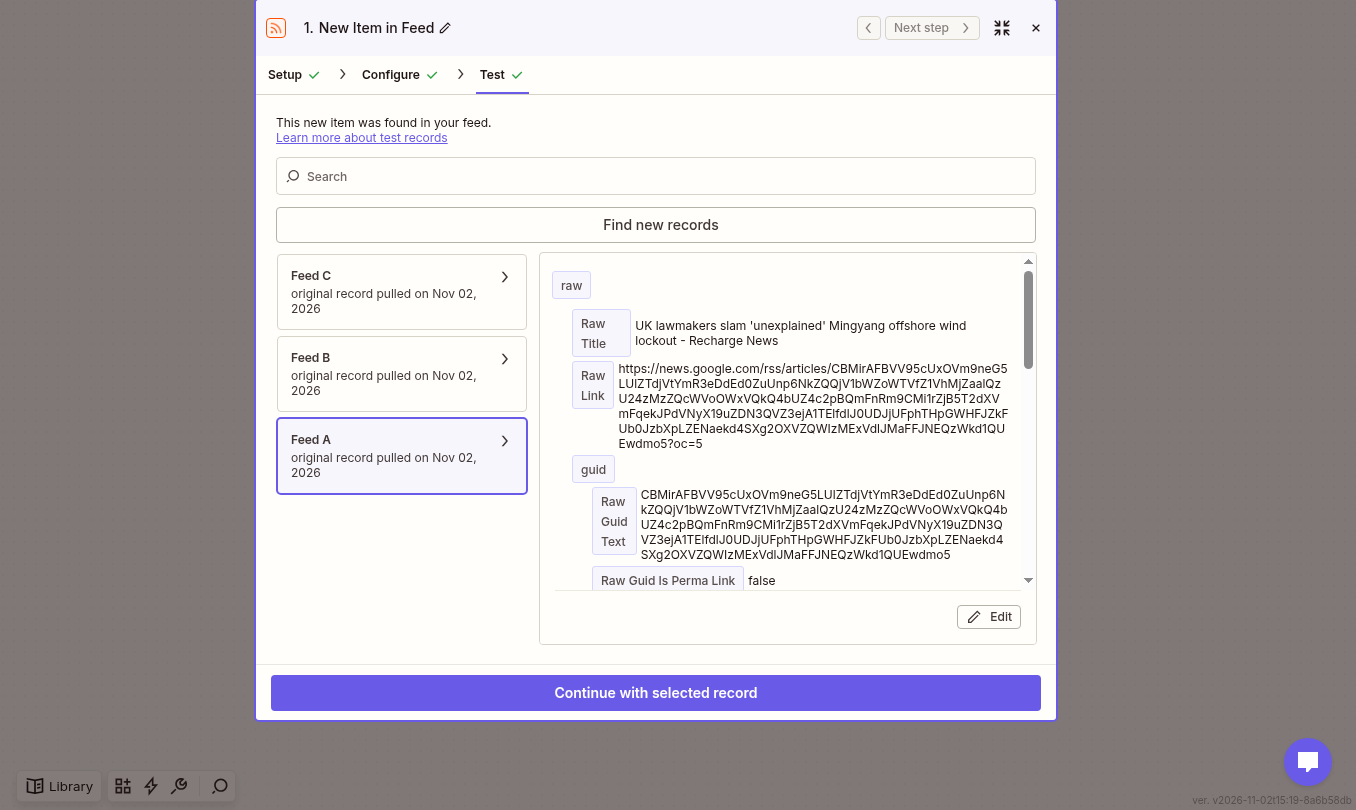
The description was an HTML snippet: the headline as a link, then the outlet name. Zapier also gave a stripped plain-text version. There was no article body anywhere, and Content was empty. The title ends with the outlet (" - Outlet"), and the outlet is also exposed as Raw Source Text and Raw Source Url. Resolving the redirect is its own job, covered in Google News redirect links to real article URLs.
Duplicates were not merged. Between two fetches 57 minutes apart, we counted 32 new items in the feed by guid (our own curl, 100 items each time). Reading headlines only, we count 3 clear pairs of the same story from two outlets (South Korea's offshore wind auction, the final turbine at the Ecowende wind farm, and the US administration's move on Orsted's wind farm approval), plus a likely fourth pair on two Norwegian floating wind projects. The Orsted pair is a judgement call. Each item had its own guid, so each is a separate item to the trigger. Why guids don't catch this is in Google News RSS duplicate stories.
The Zap ran 21 times in those 57 minutes: 15 runs in one poll about 8.5 minutes after turn-on, the rest one at a time. That is fewer runs than the 32 new guids we found between our two fetches. We did not save which item each run handled, so we can't say which ones were skipped or why. The feed is not sorted by date, and items entered and left it between polls.
Private feeds and auth
The trigger has Username and Password fields and nothing else. Feedmarkdown's pull endpoints accept only Authorization: Bearer <key> (the server reads no other header and no query-string key), so this trigger cannot read them directly. That is a limit of the trigger's inputs, not a fault in Zapier.
What works is the other direction. A feed with the webhook delivery option POSTs each new article to a URL, and a Webhooks by Zapier "Catch Hook" trigger can be that URL. Zapier's pricing page lists Webhooks and "Unlimited premium apps" under Professional, and the editor on our trial flagged Webhooks by Zapier as Premium.
Plan limits that matter for a news feed
Read from Zapier's pricing page on 2026-11-02:
| Plan | What the page says |
|---|---|
| Free | 100 tasks per month, two-step Zaps |
| Professional | From $19.99/month, multi-step Zaps, Webhooks, unlimited premium apps |
The page now shows task tiers and does not list polling intervals, so the 2 minutes above is our measurement on the trial, not a promise. As an estimate from the 1 task per run we saw, a feed of 600 new items a month with one counted action step each would use about 600 tasks, against the Free plan's 100. We did not run that volume.
What to do instead
- Low volume and headline-only alerts: stay on the Zapier RSS trigger.
- You need the text: add a step that fetches each page. The link must be the real URL first.
- You want full-text Markdown for Google News stories: have them pushed to a Catch Hook on Professional. A worked example in n8n is n8n RSS feed to Slack with full article text.
Feedmarkdown's webhook body, per its webhook contract, is one JSON object per article, signed with HMAC-SHA256 in X-Feedmarkdown-Signature. Below are its six stable fields with shortened placeholder values; the body also carries id, feed_id and source_id. We did not run it through a Catch Hook in this test.
{
  "title": "Offshore wind auction opens",
  "url": "https://example.com/offshore-wind-auction",
  "source": "Example Outlet",
  "author": "Jane Doe",
  "published_at": "2026-11-02T09:30:00Z",
  "markdown": "# Offshore wind auction opens\n\nThe full article text starts here..."
}
What we did not test
- Same-guid edits, items with no guid, reordered feeds and feeds sorted oldest first. Our Zapier-hosted test feed could not produce them.
- An access log of Zapier's polls. We did not host the feed, so we only have Zap history times.
- Bursts above 6 items at once, or a feed growing by 30. The largest single poll we saw was 15 runs, on Google News.
- The Free plan, update times on any plan other than the trial, and what header Username and Password send.
- A Catch Hook receiving a Feedmarkdown webhook, including whether it exposes request headers for checking the signature. We did not run Feedmarkdown against Zapier.
Where Feedmarkdown fits
Feedmarkdown reads Google News and Google Alerts, resolves Google News redirects to the publisher URL, drops duplicate stories before scraping and again after, and sends each new article as full-text Markdown. You get it as an HMAC-signed webhook or pull it as JSON Feed 1.1, RSS or Atom. It cannot read your own RSS feed, so for any other feed the answer is to stay on Zapier. Check intervals depend on the plan: every 6 hours on Starter, hourly on Pro, every 15 minutes on Agency (see pricing). To try it, start a 7-day trial at dash.feedmarkdown.com.