Is there a Google News API? What to use instead
No. Google has no official Google News API today. People get Google News data three ways: the Google News RSS feeds, a SERP API that reads Google's results for you, or a news API that runs its own crawl. We ran one query, "offshore wind", through each on 2026-10-08 and compared the output.
We did not cover scraping the news.google.com HTML, and nothing here is legal advice. If the terms of use matter for your project, read Google's terms and your vendor's.
What happened to the Google News API
There was one. Google announced the deprecation of its Google News Search API in 2011. On 15 January 2016 the Google Developers Blog said the APIs "will cease operations on February 15, 2016" and suggested the Custom Search API as a replacement. The post names the Google News Search API next to the Patent, Blog, Video and Image Search APIs.
The replacements did not last either. Both statuses below were checked on the vendors' own pages on 2026-10-08.
- Microsoft retired the Bing Search APIs on 11 August 2025.
- Google's Custom Search JSON API "is closed to new customers". Existing customers have until 1 January 2027 to move.
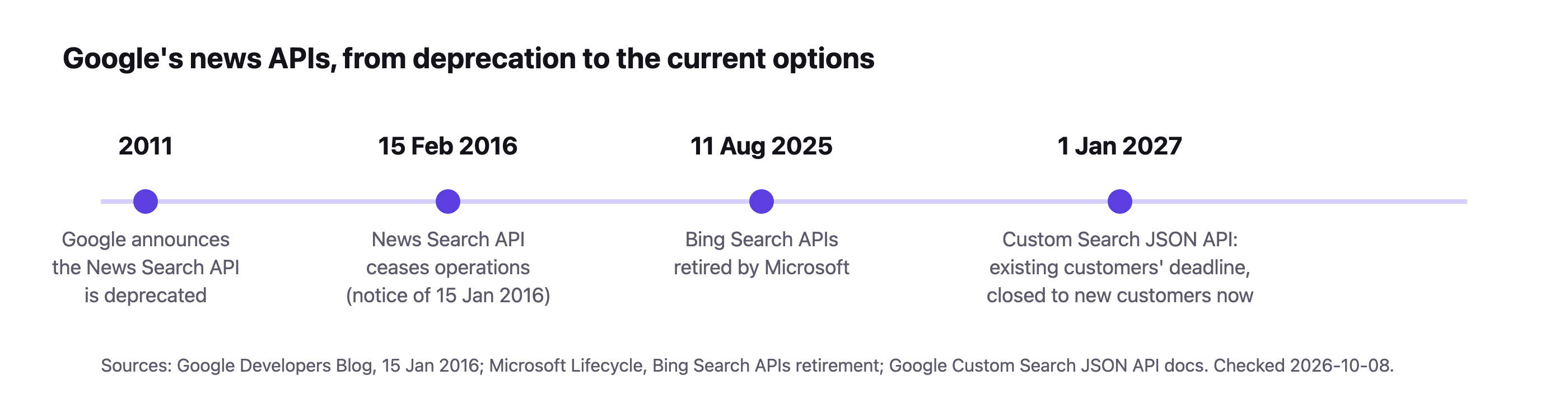
So pages that explain "how to use the Google News API" describe something that stopped working in 2016. There is also no Google News API key to get. Any key you see in a tutorial belongs to a third-party service.
Three ways to get Google News data now
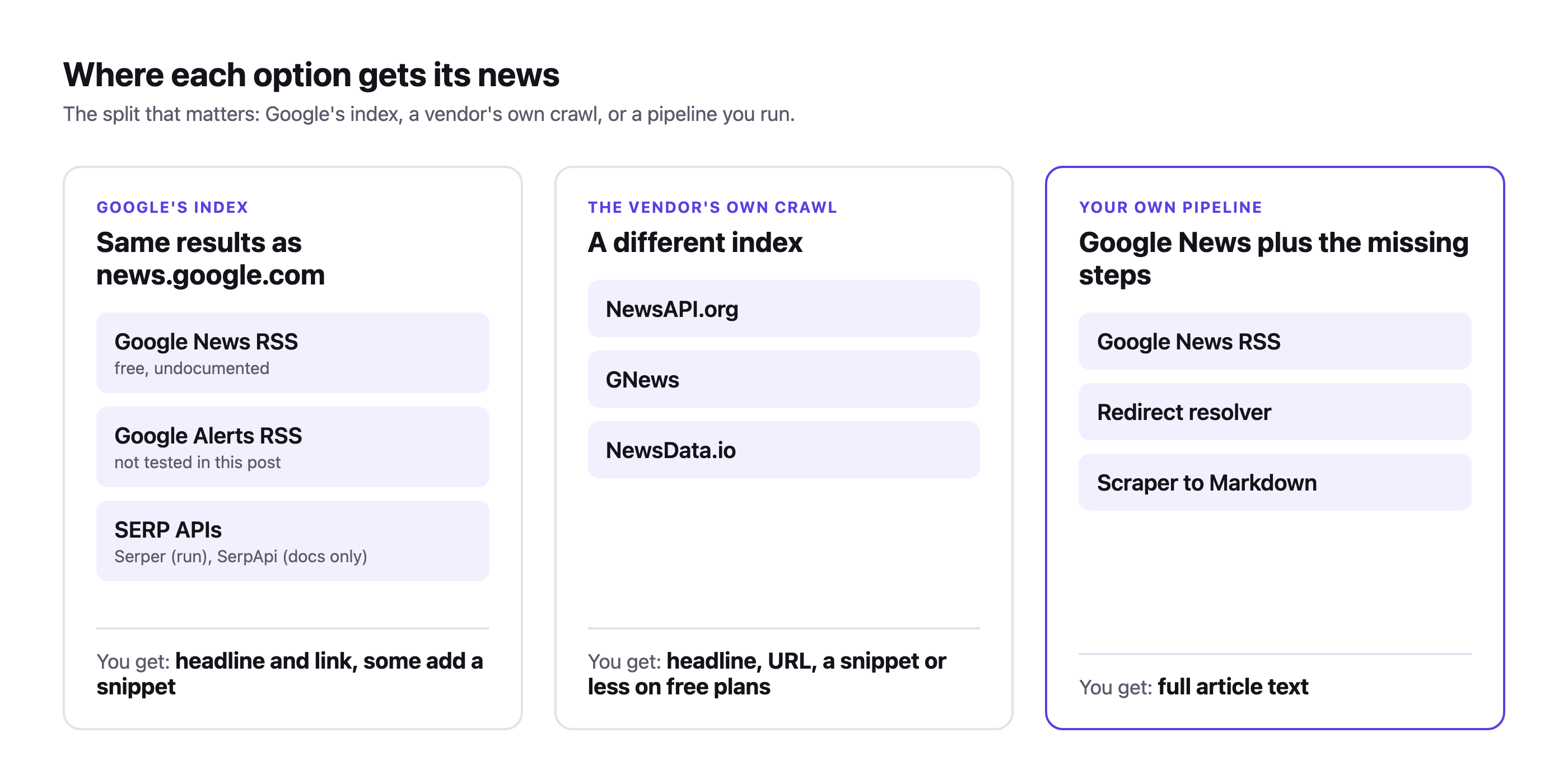
The split that matters is where the data comes from. Google News RSS and SERP APIs return what Google itself selected and ranked. A news API returns articles from the vendor's own crawl. That decides whether the results match news.google.com. Our overlap count below shows how different they can be.
We also left out Google Alerts. It can deliver to an RSS feed, but an alert has to be created in a signed-in account and we did not test one for this post.
Google News RSS, the free option
Google News serves RSS for any search. No key, no account:
curl -s -A "Mozilla/5.0" "https://news.google.com/rss/search?q=%22offshore+wind%22+when:1d&hl=en-US&gl=US&ceid=US:en"
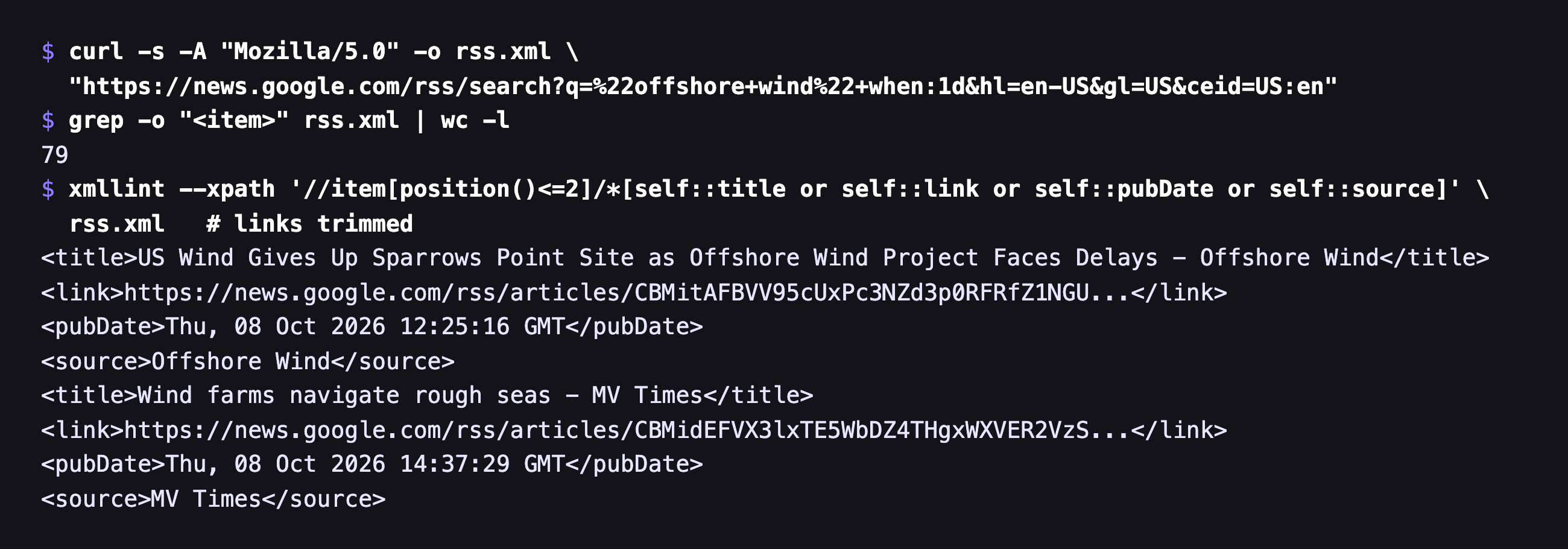
Across several calls on 2026-10-08 it returned between 78 and 82 items. One call took 0.48 seconds. The when:1d operator limits the window. The Google News RSS feed guide covers the URL formats, operators and editions, so we won't repeat them.
What you get per item: a headline with the publisher appended, a publish date, and a source name. What you don't get:
- A publisher URL. All 82 links in our main run pointed at
news.google.com/rss/articles/.... We resolved the top 20 with the method from the guide and 20 of 20 worked. It is an undocumented call and can break. - Any text beyond the headline.
- Unique stories. In that run, 82 items had 78 distinct headlines.
The feed is undocumented, so there is no published SLA or rate limit. We hit no limit in a handful of calls and did not stress it.
The same request in Python:
import urllib.parse
import xml.etree.ElementTree as ET

import requests

def google_news_rss(q):
    url = "https://news.google.com/rss/search?" + urllib.parse.urlencode(
        {"q": f"{q} when:1d", "hl": "en-US", "gl": "US", "ceid": "US:en"})
    root = ET.fromstring(requests.get(url, headers={"User-Agent": "Mozilla/5.0"}, timeout=30).content)
    return [{"title": i.findtext("title"), "url": i.findtext("link"),
             "source": i.findtext("source"), "published_at": i.findtext("pubDate")}
            for i in root.iter("item")]

print(len(google_news_rss("offshore wind")))
SERP APIs that return Google News results
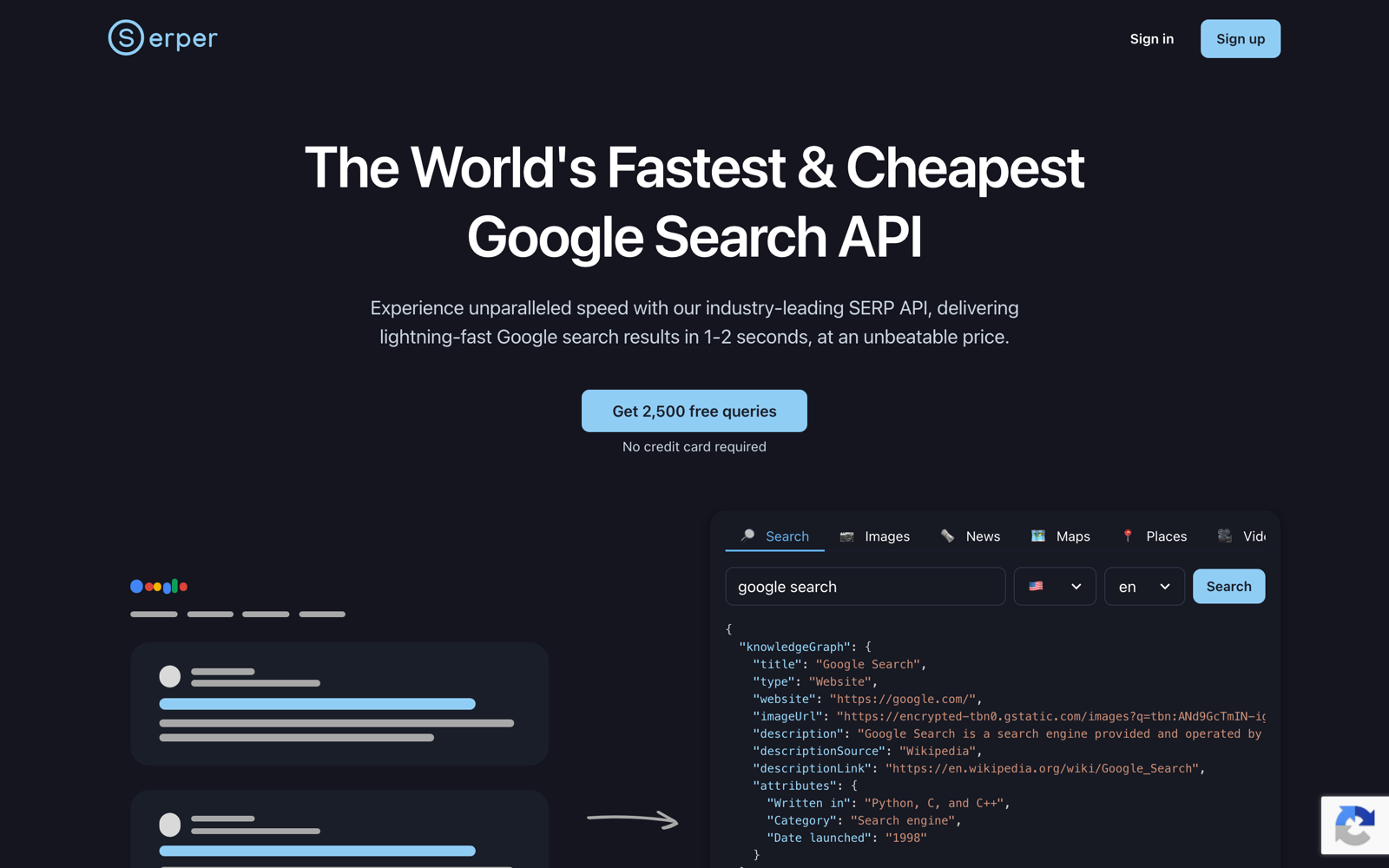
A SERP API runs the Google search for you and returns the News results as JSON, with real publisher URLs. We ran Serper (serper.dev):
curl -s -X POST https://google.serper.dev/news \
  -H "X-API-KEY: $SERPER_KEY" -H "Content-Type: application/json" \
  -d '{"q":"offshore wind","gl":"us","hl":"en","tbs":"qdr:d"}'
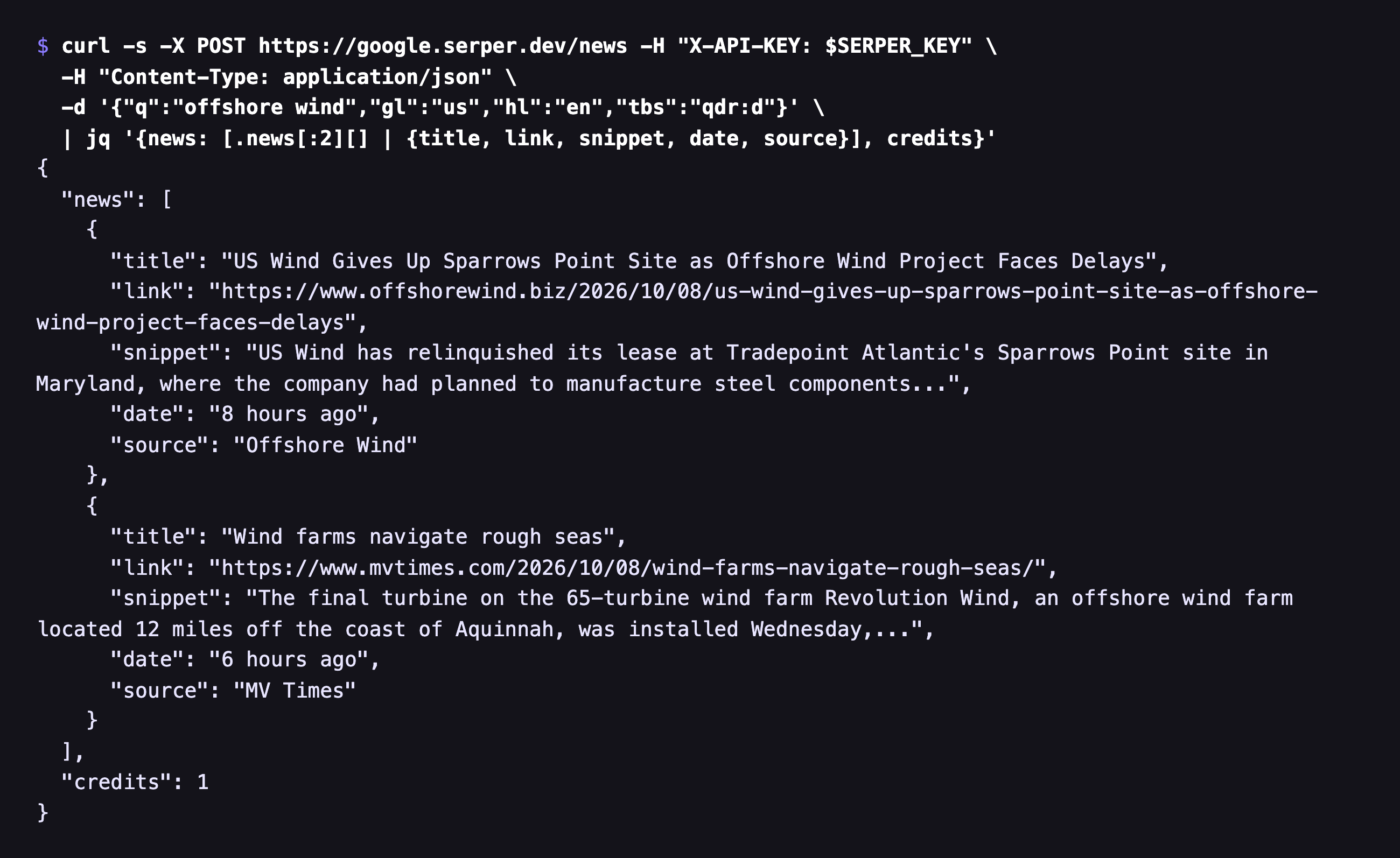
It returned 10 results per call, all with publisher URLs and a snippet of up to 159 characters, for 1 credit. All 10 were in the top 20 of the RSS feed. That fits a service that reads Google's own results. There is no article text, and dates are relative, such as "8 hours ago".
Pricing, checked on serper.dev on 2026-10-08: 2,500 free queries with no card, then $50 for 50,000 credits ($1.00 per 1,000), with credits valid for 6 months.
SerpApi has a google_news engine. We did not run it because we had no key. From SerpApi's documentation, not run by us: the request is GET https://serpapi.com/search?engine=google_news&q=QUERY&api_key=YOUR_API_KEY, and the example response has a news_results array whose items carry position, title, source.name, link (the publisher URL) and iso_date. Their docs example uses the query "pizza" and a 2024 date. It is excluded from every count in this post.
Pricing, checked on serpapi.com on 2026-10-08: a free plan with 250 searches a month, then Starter at $25 a month for 1,000 searches. That is $25 per 1,000 against Serper's $1.00, so for this job Serper is far cheaper per call. We did not compare their result quality.
News APIs with their own index
NewsAPI.org, GNews and NewsData.io each run their own crawl. All three are keyed, documented and have free plans. We used free keys only and queried the same phrase. Plan details are from each vendor's pricing page on 2026-10-08.
NewsAPI.org
The free Developer plan is $0, 100 requests a day, a 24 hour article delay, a month of history, and "development and testing" use only, not staging or production. Business is $449 a month for 250,000 requests and real-time articles. Our last-24-hours query returned 0 articles, which fits the delay. A 7 day query returned 27, each with a snippet of up to 215 characters and a [+1569 chars] style note where the text was cut.
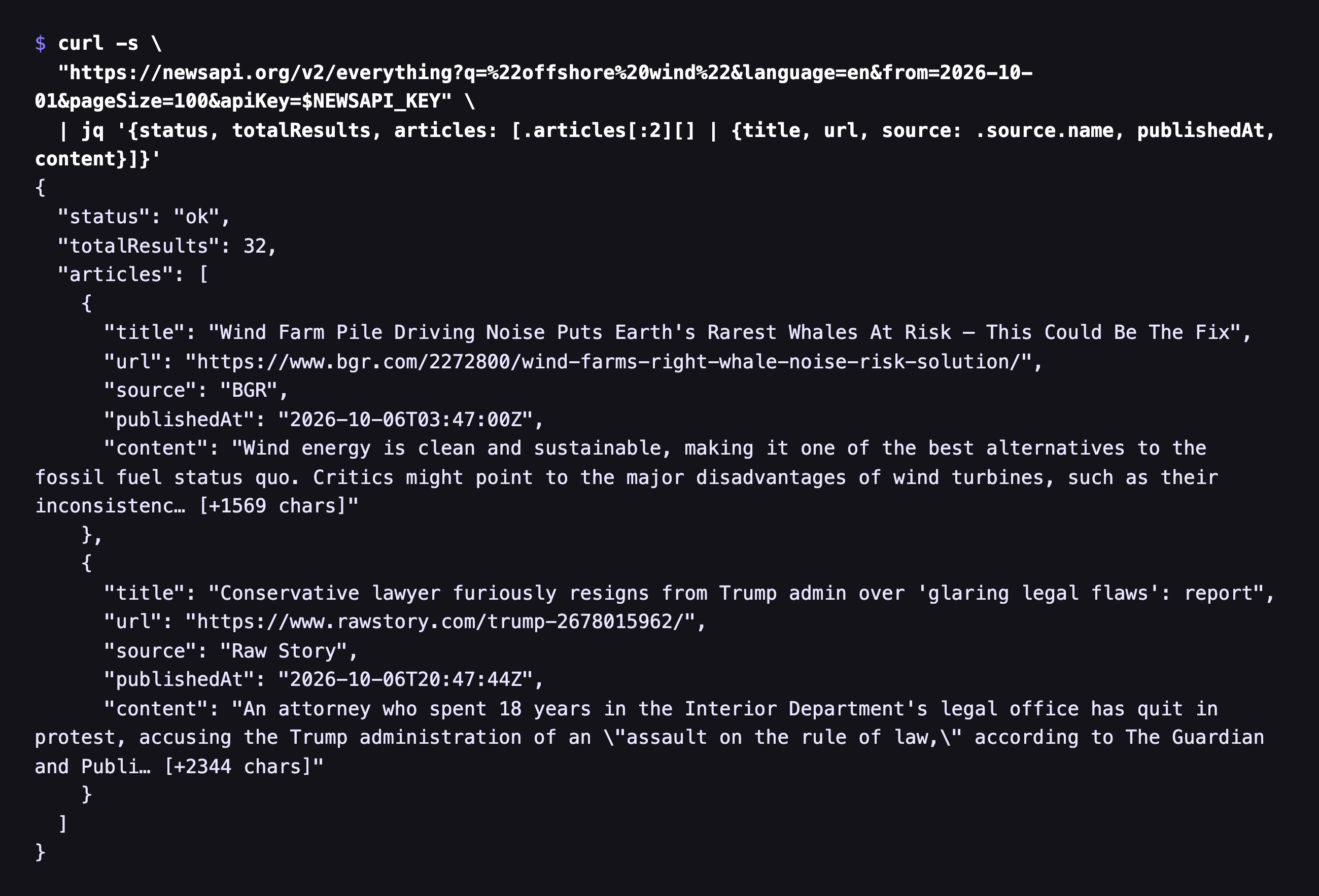
The screenshot is a later call the same day, so its total (32) is higher than the 27 in our main run.
GNews
Free is €0 with 100 requests a day, 10 articles per request, a 12 hour delay, 30 days of history, and "non-commercial projects, development and testing only". Essential is €49.99 a month for 1,000 requests a day and real-time articles. Our last-24-hours query returned 0. Without a time filter it returned 10, with content cut to about 267 characters. Our first run got HTTP 429 until we added a pause between providers.
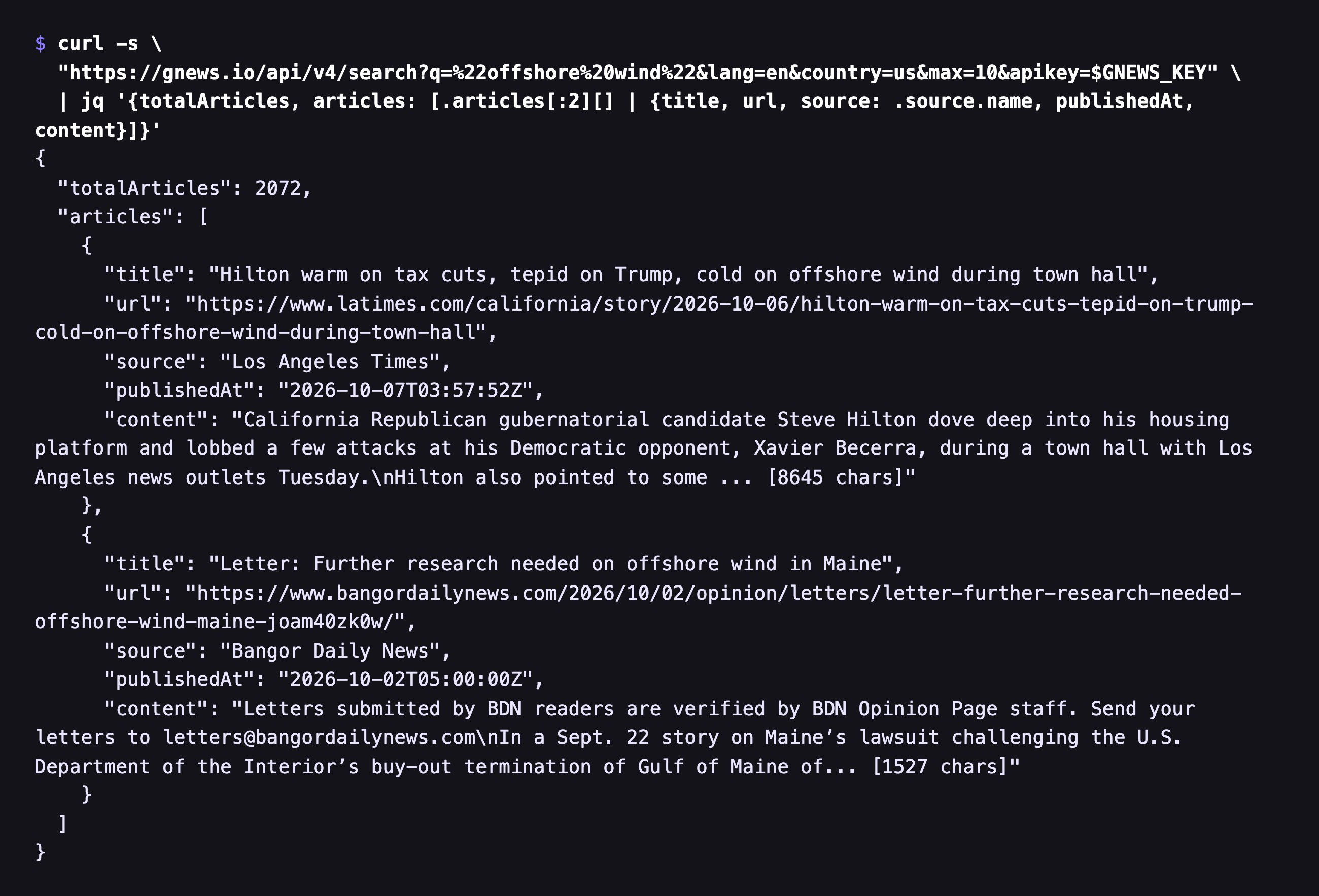
Note the dates: with no time filter, the top results were one and six days old.
NewsData.io
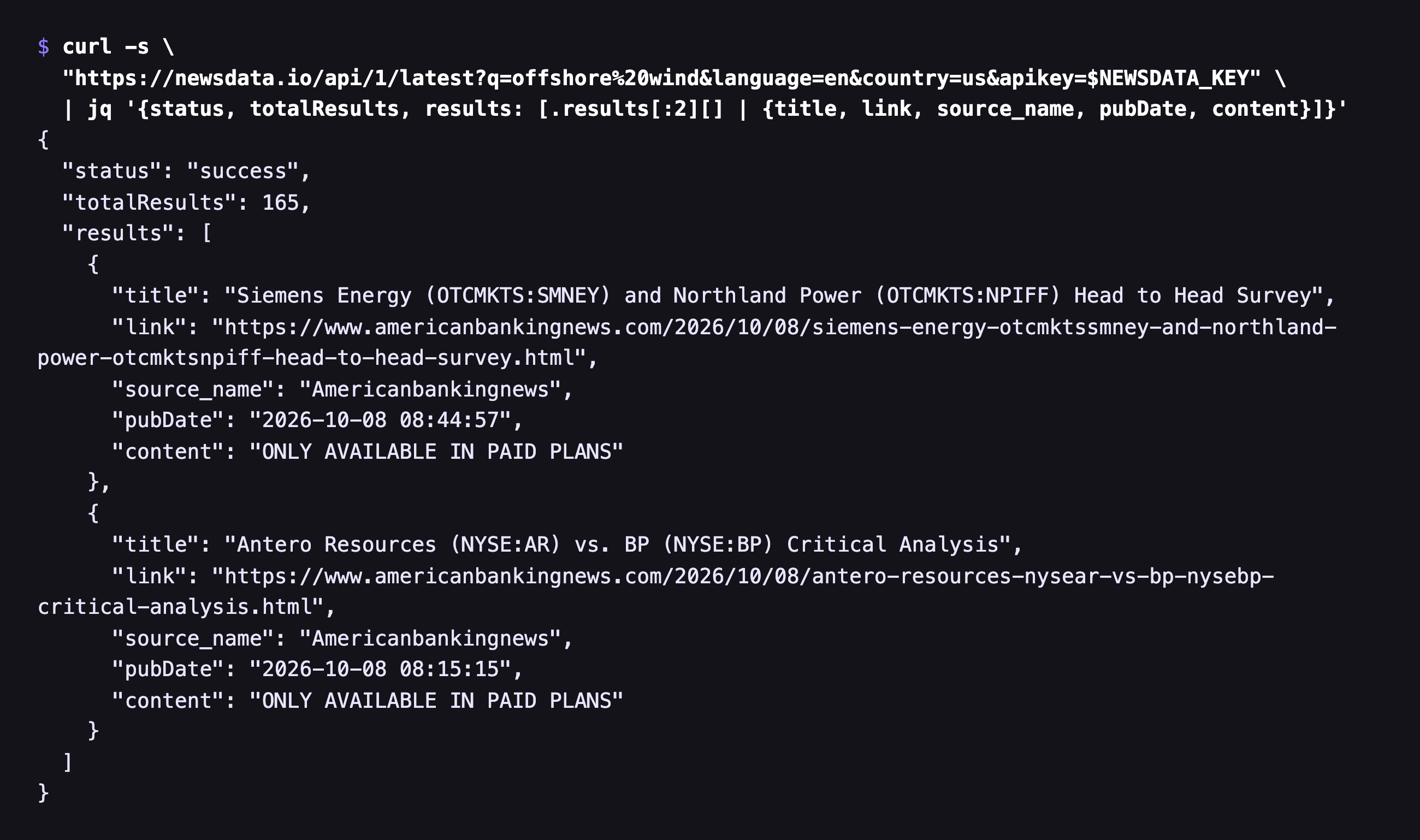
Free is $0 with 200 credits a day, 1 to 10 articles per credit and a 12 hour delay. Basic is $199.99 a month for 20,000 credits and 6 months of history. Its pricing page puts no commercial-use limit on the free plan, and its terms (re-read 2026-11-02) say users "can use the data for their personal or professional purposes", with copyright left to the user. It returned 10 articles. The content field held an "only available in paid plans" placeholder, so there was no text. The top results were a press release and stock-comparison pages. For a deeper side-by-side of NewsData.io and Newscatcher, see Newscatcher vs NewsData.io, and when to skip both.
None of them is Google News. The overlap shows it.
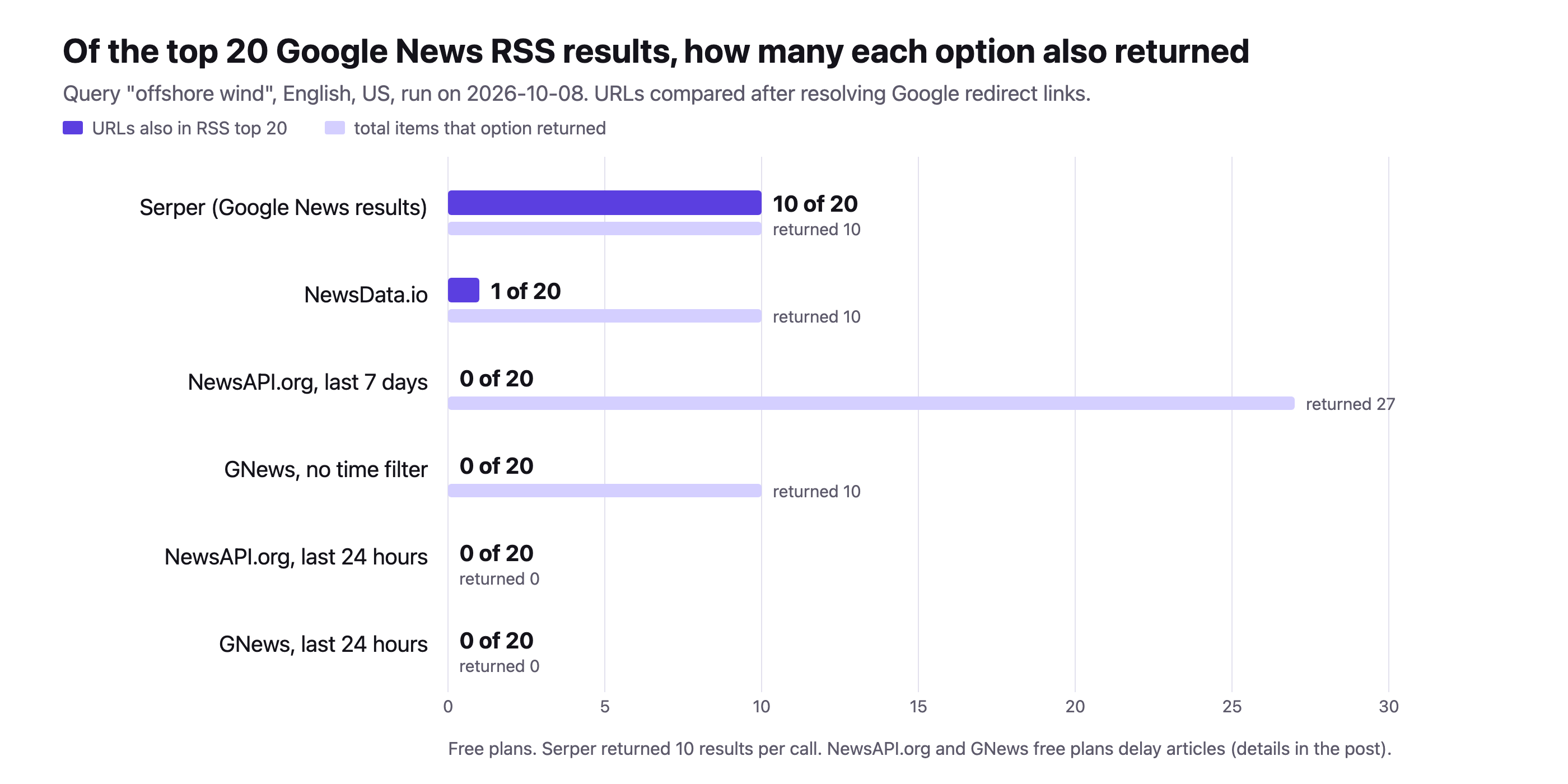
This is one query on one day, with free plans that delay articles. Don't read it as a quality ranking. It does show that a news API will not reproduce Google News results.
Where they beat the RSS feed: they are documented, keyed and stable, they filter by language, country and date, and the paid plans reach back months or years. Our 27 NewsAPI.org items from the past week have no equivalent in an RSS feed that returns around 100 recent items. If you need history or filters, use one of them.
What about the Bing News API
It's gone. Microsoft's lifecycle page says the Bing Search APIs retired on 11 August 2025, that existing instances were decommissioned, and that new signups ended. It points customers to "Grounding with Bing Search" in Azure AI Agents. That feature lets an AI agent use web data when it answers. It is not a news feed API. We did not test it.
Side by side on one query
Test query "offshore wind", English, US, run on 2026-10-08. Prices checked the same day. The Serper entry price is the $50 pack.
| Option | Data source | Items | Publisher URLs | Article text | Time filter | Free tier | Entry price |
|---|---|---|---|---|---|---|---|
| Google News RSS | Google's index | 82 | 0 (redirects) | None | when:1d |
Free, no key | Free |
| Serper | Google's index | 10 | 10 | Snippet, up to 159 chars | tbs=qdr:d |
2,500 queries | $50 for 50,000 credits |
| NewsAPI.org | Own crawl | 0 in 24h, 27 in 7d | 27 | Snippet, up to 215 chars | from |
100 requests/day, 24h delay, dev use only | $449/month |
| GNews | Own crawl | 0 in 24h, 10 unfiltered | 10 | Snippet, up to 267 chars | from |
100 requests/day, 12h delay, non-commercial | €49.99/month |
| NewsData.io | Own crawl | 10 | 10 | None on free | Not used | 200 credits/day, 12h delay | $199.99/month |
SerpApi is not in the table because we did not run it. Alerts is not in it either.
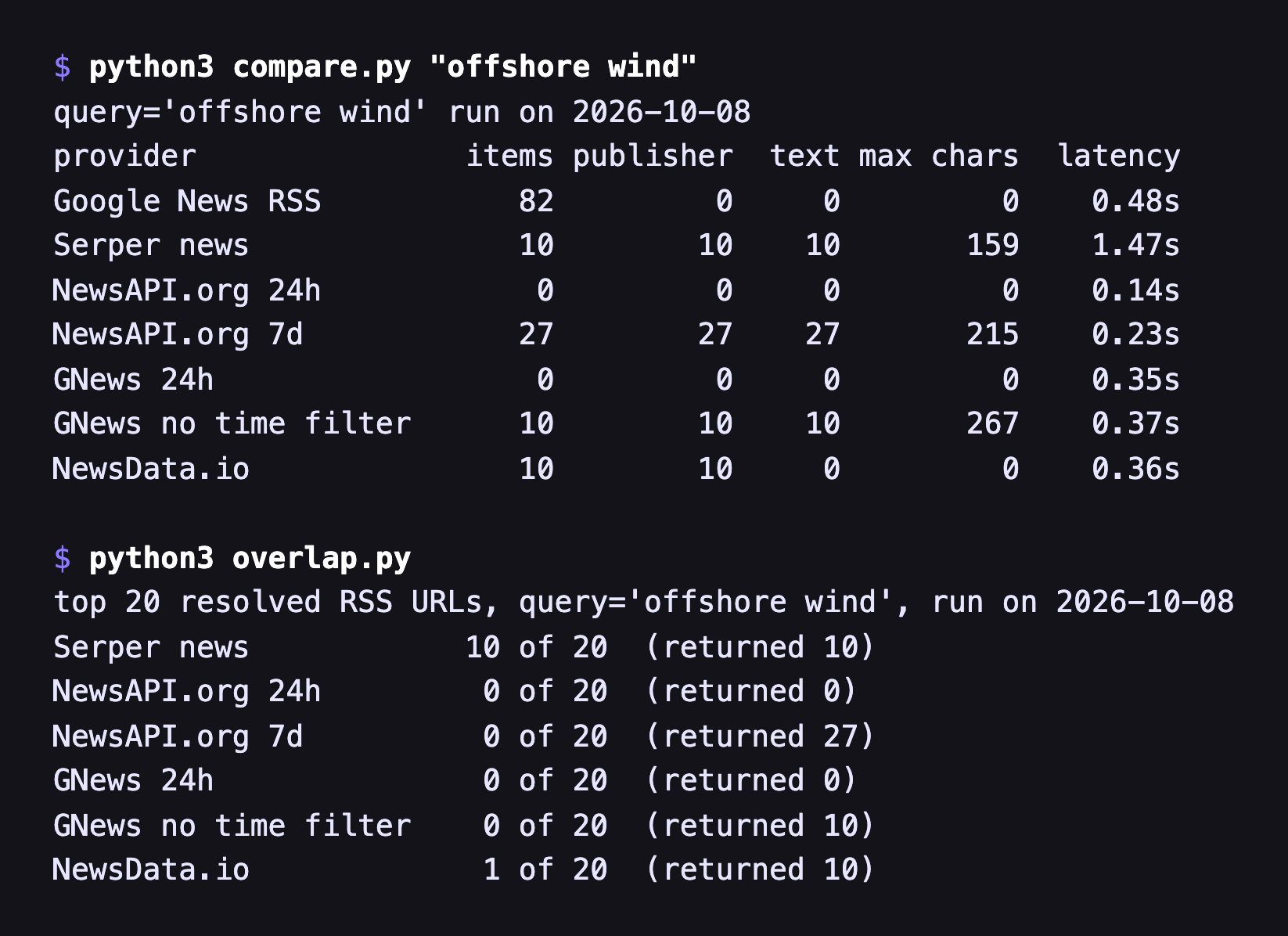
What the numbers say:
- No option returned full article text. The best was a snippet of a few hundred characters.
- The only options with publisher URLs and no delay were the SERP API and, after resolving, the RSS feed.
- Free news API plans delay articles by 12 to 24 hours. For "what happened today" that rules them out. We did not compare publish times for a shared story, because Serper only gives relative dates like "8 hours ago".
- Single-call latency in the run shown was 0.14 to 1.47 seconds. We did not benchmark beyond one call per provider, and Serper took 3.18 seconds in an earlier run.
What each option costs
All prices from each vendor's own pricing page on 2026-10-08. Paid tiers listed are the entry plan and the next one up.
| Option | Free | Entry paid plan | Next plan | Free tier allows commercial use |
|---|---|---|---|---|
| Google News RSS | Unlimited, undocumented | n/a | n/a | Read Google's terms |
| Serper | 2,500 queries, no card | $50 for 50,000 credits ($1.00/1k), valid 6 months | $375 for 500,000 ($0.75/1k) | No restriction stated |
| SerpApi | 250 searches/month | $25/month, 1,000 searches | $75/month, 5,000 searches | No restriction stated |
| NewsAPI.org | 100 requests/day, 24h delay | $449/month, 250,000 requests | $1,749/month, 2,000,000 requests | No, development and testing only |
| GNews | 100 requests/day, 12h delay | €49.99/month, 1,000 requests/day | €99.99/month, 5,000 requests/day | No, non-commercial only |
| NewsData.io | 200 credits/day, 12h delay | $199.99/month, 20,000 credits | $349.99/month, 50,000 credits | Terms allow commercial use |
| Google Custom Search JSON API | 100 queries/day | $5 per 1,000 queries, up to 10,000/day | n/a | Closed to new customers |
| Bing Search APIs | n/a | n/a | n/a | Retired 11 August 2025 |
| Feedmarkdown | n/a | $19/month, 10 sources | $49/month, 50 sources | n/a |
The cheap options give you headlines. The free news API tiers are delayed and, for two of the three, not allowed in production. Real-time news API access starts at €49.99 to $449 a month, and none of the free plans we tested returned full article text.
For the layers above the data source, scraper, dedupe and server, see what a newsletter's news stack costs per month.
Which one to use
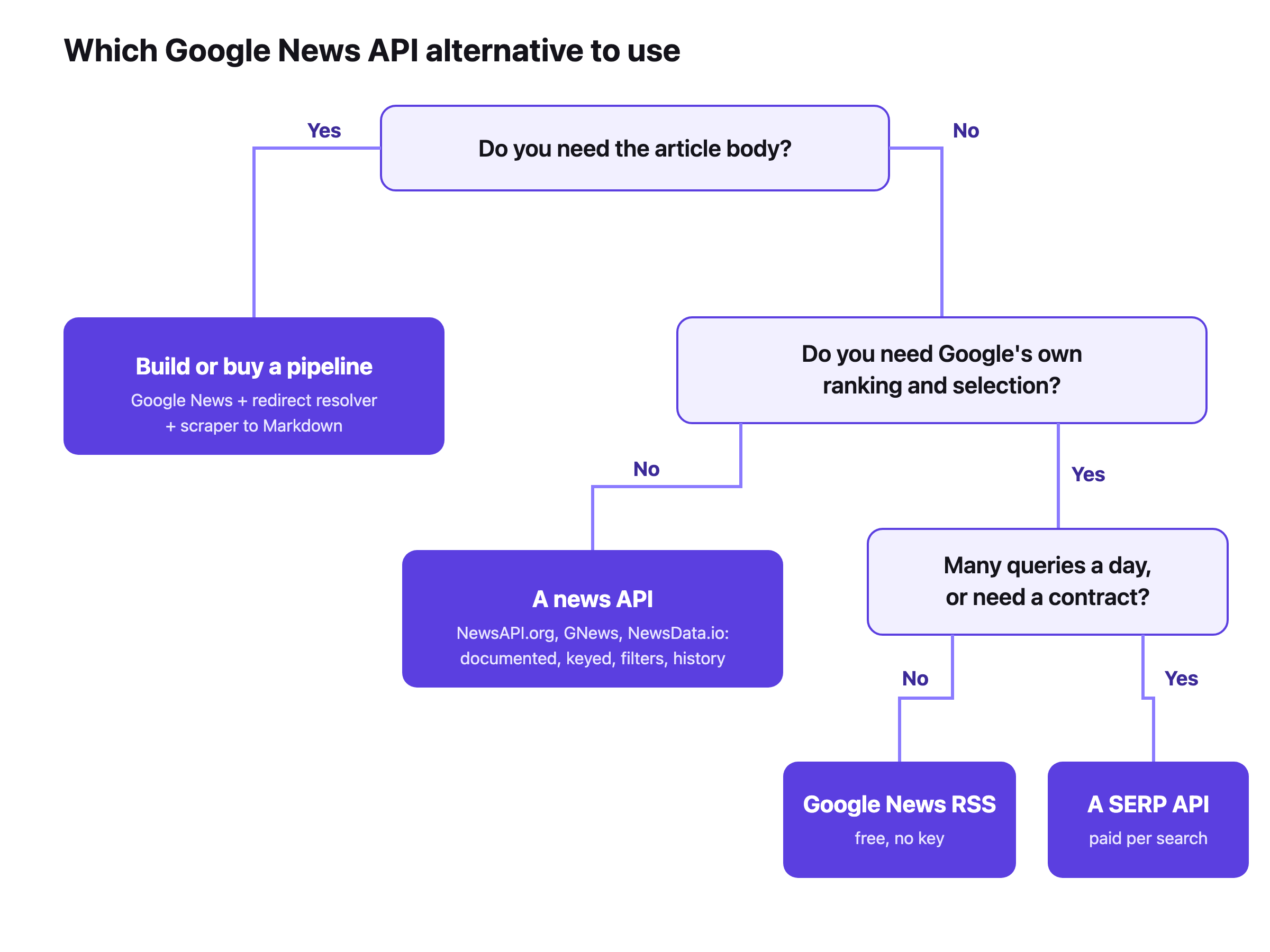
- Need Google's selection, for free: Google News RSS.
- Need Google's selection at volume, or with a vendor to call: a SERP API.
- Need a documented API, filters or history: a news API.
- Need the article text, deduplicated: build the pipeline or buy it. For hosted full-text expansion tools, see PolitePol and FiveFilters alternatives.
Short answers
Is there a free Google News API? There is no Google News API. The free options are the RSS feeds and the free plans of third-party services, which come with the delays above.
Does Google News have an API key? No.
Is it legal to use Google News RSS? We can't say. Read Google's terms.
Skip the plumbing
The last branch of the tree is what Feedmarkdown does. It reads Google News, resolves redirects to publisher URLs, dedups across sources before scraping, and returns each article as full-text Markdown by HMAC-signed webhook, or as JSON Feed 1.1 or Atom you pull. It is not a news API with its own index or archive. If you need years of history or wide language filters, pick a news API. Plans start at $19 a month for 10 sources checked every 6 hours; see the pricing section, or start from the home page.